Voice & communication
Telephone & Intercom Cables
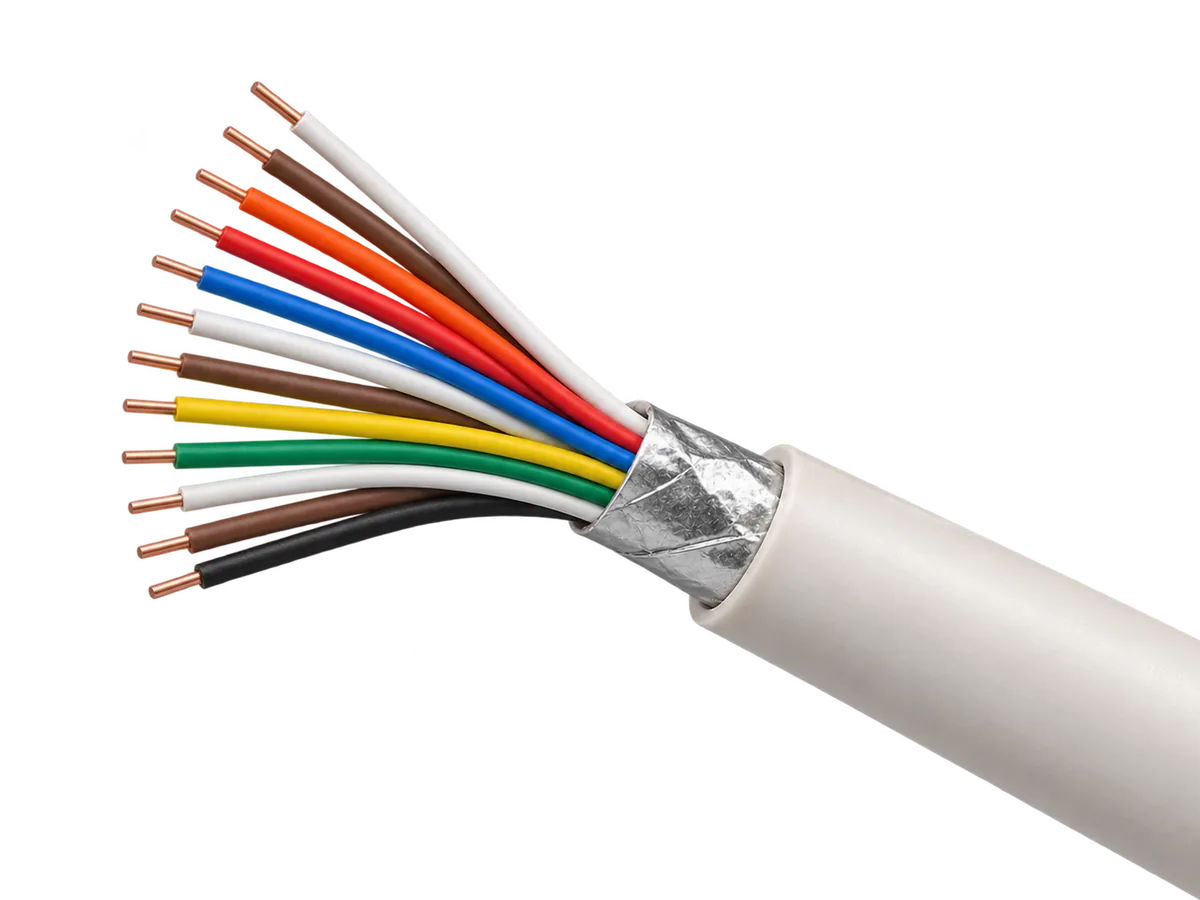
Telephone and intercom cables for telephone lines, PABX exchanges and building intercoms. We make copper telephone wire from a single pair to 100 pairs, plus aerial and indoor intercom cable.
- 1 to 100 pairs
- 0.4, 0.5 & 0.6 mm
- 99.9% pure copper
- Aerial & indoor
ISO 9001:2015 certified. Manufacturing since 1994.
About our telephone and intercom cables
- Conductor
- 99.9% pure copper
- Pair counts
- 1 pair to 100 pairs
- Conductor sizes
- 0.4, 0.5 and 0.6 mm
- Intercom types
- Aerial and non-aerial
- Insulation
- Colour-coded cores
- Sheath
- PVC outer sheath
Telephone and intercom cables carry voice and signalling between handsets, exchanges, door stations and distribution boxes. Each circuit uses a pair of colour-coded copper conductors, and one cable can carry many pairs, so a whole floor or building can be wired with a single run.
We make telephone cable from a single pair up to 100 pairs, and intercom cable in two forms: non-aerial cable for runs inside buildings and conduit, and aerial cable with a built-in steel support wire for runs between poles and buildings. All use 99.9% pure copper conductors, colour-coded insulation and a PVC outer sheath.
Used for
PABX & office exchanges
Intercom & door-entry systems
Apartments, offices & hotels
Construction
How telephone cable is built
Four parts: copper conductors, colour-coded core insulation, a foil wrap on screened types and the outer sheath.

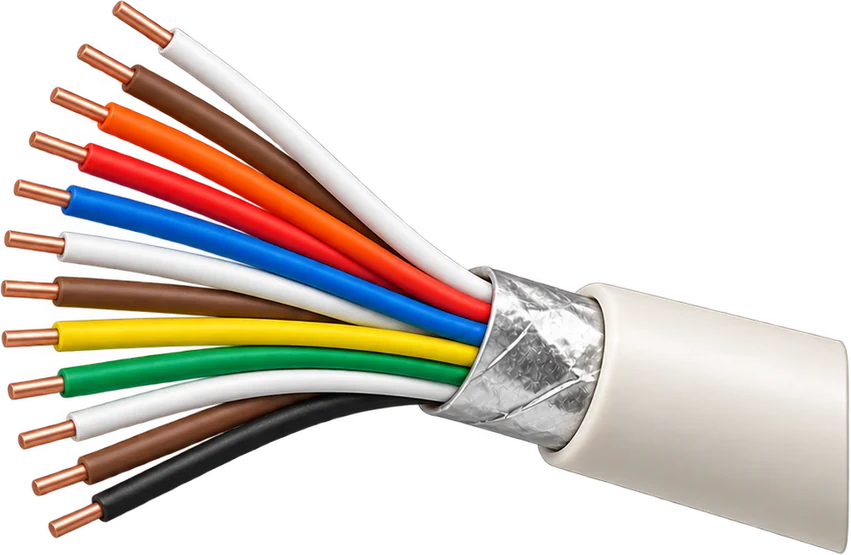
Illustrative construction; conductor arrangement and screening vary by product. Diagram not to scale.
Copper conductors
99.9% pure copper conductors, two for each circuit. The number of pairs sets how many lines the cable carries.
Core insulation
Insulation in different colours, so each conductor can be traced from one end of the cable to the other.
Foil wrap
On screened types, a metal foil around the cores that helps keep electrical noise out of the lines.
Outer sheath
A PVC sheath that protects the cores. Aerial intercom cable adds a steel support wire moulded into the sheath.
Telephone cable types and pair counts
Telephone cable is ordered by the number of pairs. One pair carries one line.
Telephone pair counts
Commonly used pair counts. Each pair is two colour-coded copper conductors.
- 1 pairSingle pairOne line
- 2 pairMulti-pairTwo lines
- 5 pairMulti-pairSmall offices
- 10 pairMulti-pairOffice floors
- 20 pairMulti-pairDistribution
- 30 pairMulti-pairDistribution
- 50 pairMulti-pairBuilding risers
- 100 pairMulti-pairExchange feeders
Conductor sizes
Diameter of each solid copper conductor.
- 0.4 mmSolid copperShort indoor runs
- 0.5 mmSolid copperMost installations
- 0.6 mmSolid copperLonger runs
Other pair counts up to 100 pairs on request. Tell us the pair count, conductor size, aerial or non-aerial, the length and your delivery city.
Made in Pakistan, tested and documented
Manufacturing since 1994
Made at our Lahore factory and delivered to customers across Pakistan for over three decades.
ISO 9001:2015 certified
Certificate CV/QMS/AC/536 issued by CertVeritas. Scope: manufacturing of electrical wires and cables.
Test reports on request
Ask for applicable PCSIR product test reports and copper-purity reports when reviewing your cable choice.
Telephone & Intercom Cables FAQs
What is telephone cable used for?
It carries landline telephone and PABX extension lines from the exchange or distribution box to each handset. It is also used for intercoms, door-entry systems and other low-voltage signalling in homes, apartments, offices, hotels and hospitals.
How many pairs do I need?
One pair carries one telephone line or extension, so count the lines you need and allow some spare pairs for faults and future extensions. For example, an office with 16 extensions would normally use a 20-pair cable. Your installer can confirm the count for your system.
What is the difference between aerial and non-aerial intercom cable?
Aerial cable has a steel support wire built into the sheath. The steel wire takes the weight when the cable is hung between poles or buildings, so the copper conductors are not stretched. Non-aerial cable has no support wire and is used inside buildings, in ducts and in conduit.
Can I use telephone cable for internet or CCTV?
Telephone cable is made for voice lines and low-speed signalling. For computer networks and IP cameras use CAT6 network cable, and for analogue CCTV cameras use coaxial or CCTV cable. We make all three.
Which conductor size should I choose: 0.4, 0.5 or 0.6 mm?
A thicker conductor has lower resistance, so the line works over a longer distance. 0.5 mm is the size used in most telephone and intercom installations. 0.4 mm suits short runs inside a building, and 0.6 mm is chosen for longer runs. Follow your system supplier's recommendation if you have one.
Are the conductors copper?
Yes. Our telephone and intercom cables use 99.9% pure copper conductors, not copper-clad aluminium or copper-clad steel.
What is the telephone cable price in Pakistan?
Price depends on the pair count, the type and the quantity. Send your requirement through the quote form or WhatsApp for current prices and delivery to your city.
Other cables you may need
Get a quote
Request a telephone cable quote
Share the size, quantity and delivery city. The form opens WhatsApp with your enquiry ready to send.
WhatsApp Business0335 4172122Emailazizcablesltd@gmail.comVisit / locationMubarak Plaza, opposite Canal View Gate No. 3, Multan Road, Lahore, Pakistan
What happens next
- Share the size, quantity and delivery city.
- Our team reviews the details and confirms availability.
- Receive a quotation for the agreed size and quantity.
Request a quote
This opens WhatsApp with your enquiry. Review the message and send it to our team.